Original Post: December 9, 2022
Deputy Sheriffs executing “civil” process, commit home invasion, kidnapping, and false imprisonment
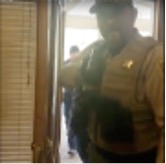
This type of tyranny is why the Revolutionary War was fought (and won)!
FOR VERIFICATION OF STATUTES DISCUSSED GO TO: nmonesource.com
TO LOOK UP COURT CASES IN NEW MEXICO GO TO: caselookup.nmcourts.gov
NOTE: The purpose of this post is to show the lengths the sheriffs will go to in order to remove someone from their home at the behest of servicer law firms. The sheriffs are acting as paid thugs and henchmen, and not in the capacity in which they are elected to act, something we will explore on this page. While I do not agree with the way the homeowner went about this challenge, as I have learned that most people engaged in these acts are really not bad people and they do not like having to do this, it is important to read this in the proper context. Understand that foreclosure sales are conducted without due process by servicers and their attorneys who have no right to the property and the sheriffs are acting under a contract with these sheriffs, under the guise of obligation to a “court order”.
The “criminal” case (malicious abuse of process, criminal acts) against the homeowner shown here who is victim of this vicious home invasion is M-30-MR-2022-00109
The “Foreclosure” case of this victim homeowner is D-1226-CV-201700057.
The right of the people to be secure in their persons, houses, papers, and effects, against unreasonable searches and seizures, shall not be violated, and no Warrants shall issue, but upon probable cause, supported by Oath or affirmation, and particularly describing the place to be searched, and the persons or things to be seized. U.S. Const. Am. IV
The people shall be secure in their persons, papers, homes and effects, from unreasonable searches and seizures, and no warrant to search any place, or seize any person or thing, shall issue without describing the place to be searched, or the persons or things to be seized, nor without a written showing of probable cause, supported by oath or affirmation. N.M. Const. Art II Sec. 10
What is a “Writ of Assistance”?
In New Mexico (and likely every other state), it is a type of CIVIL process, much like a Summons or Subpoena. The only difference between a sheriff serving a Writ and a process server serving a summons is that the sheriff has exclusive authority to execute/serve writs of assistance. In New Mexico, sheriffs derive this authority from a magistrate court statute. It is intended to remove non-owners of property through a civil action. New Mexico magistrate courts are courts of limited jurisdiction (N.M. Const. Art VI Sec. 6). These courts can only hear cases of controversies less than $10,000 and cannot adjudicate disputes of title to property (NMSA 1978 Sec. 35-3-3C).
Writs of assistance are brought under the “Forcible Entry and Detainer Statute” in magistrate court. State District Courts have concurrent jurisdiction under this statute (NMSA 1978 Sec. 35-10-1B). The fact that a request for a writ of assistance under this statute is brought in state district court does not expand the jurisdiction under which this request is brought! The district court judge is simply acting as a magistrate in this situation. The specific provision states, “The district court of the county in which the real property is located has concurrent original jurisdiction in civil actions for forcible entry or unlawful detainer when the rent contracted for amounts to fifty dollars ($50.00) or more a month or when the reasonable rental value of the premises is fifty dollars ($50.00) or more a month.” The property subject to a foreclosure on a mortgage is always worth more than $10K and it does not involve rent.
The law firm in this case (Aldridge Pite LLP) enters appearance after the “sale” in order to initiate “eviction” proceedings. It repeatedly claims to enter “limited” appearance under a metropolitan court rule. In case T-4-CV-2022-009072, this same firm attempted to get a writ of assistance in metropolitan court after a “foreclosure sale” but was dismissed for lack of jurisdiction. The smoke and mirrors occurs when a “plaintiff” (misnomer because the named plaintiffs have NO interest in these foreclosure cases) seeks a writ of assistance in the same foreclosure case post-“sale”.
FIRST: a foreclosure does not necessarily litigate title to property but instead forecloses on the lien and inferior interests, e.g. other liens (ROMERO V. STATE, 1982-NMSC-028, 97 N.M. 569, 642 P.2d 172 (S. Ct. 1982)).
SECOND: title is NEVER litigated in foreclosure cases.
THIRD: a “special master’s deed” derived from a judgment lien is equitable title.
FOURTH: possession is contingent upon strength of title and right to possession at the time of filing complaint (NMSA 1978 Sec. 42-4-1, A right to possession of the premises at the time of filing the complaint is essential to maintaining ejectment both at common law and, indeed, under the statutory law of New Mexico. Kerr-McGee Corporation v. Bokum Corporation, 453 F. 2d 1067 – Court of Appeals, 10th Circuit 1972.
Sheriffs in New Mexico are fully aware that the execution of these “evictions” are done under their civil authority. In fact, it is not done under a “civil authority” but a contractual agreement with a paralegal from the law firm representing the “plaintiff”. Sheriffs are paid a fee to execute these writs and therefore this home invasion was literally done by an agent for the plaintiff, which, by they way, acquired an equitable interest by paying another private individual to convey the property to itself.
Details about how special master sales are conducted, who (or what) is behind them, and how property is “transferred” are forthcoming. In short, there is no evidence that the property is owned by the “plaintiff”. In fact, in this case, the “plaintiff” was substituted post-judgment and post-“sale”. How could this happen in a foreclosure case that has been closed and judgment satisfied ?? It can’t. The corporate Wall Street entity, which purports to have an interest in this property is claiming ownership based on a “quitclaim deed” from the alleged “purchaser” at the sale and the case caption was amended to show the new claimant as “plaintiff” in a foreclosure case. In the meantime, the woman who was kidnapped in this video claims ownership via a land patent, which is considered perfect legal title.
Let that sink in.
They bypassed critical due process steps in order to gain possession of the property. They should have, instead, filed a separate action for quiet title or ejectment; however, they would have lost because they would not be able to prove superior title by virtue of a “special master’s deed” when there is no evidence that a “bid” was ever made and when it wasn’t even the named “special master” that conducted the so-called sale. This is not to mention that the action should have been brought in probate court jurisdiction, because it involves an estate of a decedent who has heirs who were never even given notice of this action. The issues with this go on and on. The defendant “Estate of …” is a non-existent entity and heirs to the property were never noticed of the action making the judgment void (IN THE MATTER OF THE ESTATE OF HELENA DE GRAAF, No. A-1-CA-35128, NM Court of Appeals).
The deputy sheriffs that arrested these two victims had no “public” (legitimate) authority to break in and arrest them at gunpoint. This is exactly the definition of home invasion, kidnapping, and false imprisonment. That “writ of assistance” is void, e.g. without authority because everything underlying is without authority. However, even if there was authority, this “civil process” was executed upon payment from the “plaintiff’s” attorney. E.g. the sheriff acted as an agent of the attorney. The sheriff acted as an agent of Wall Street!
Read the “Statement of Probable Cause” here, does anything jump out at you?
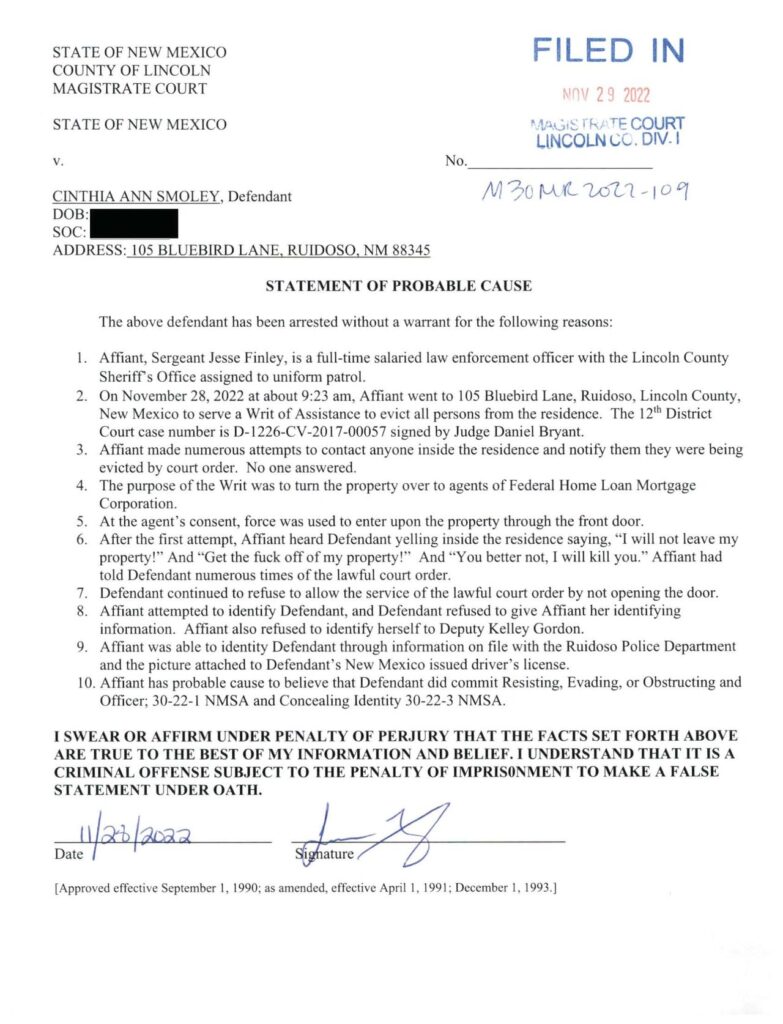
Sergeant Jesse Finley swears, under penalty of perjury, that his authority to break down the door, AT GUNPOINT (e.g. home invasion) was given by “agents of Federal Home Loan Mortgage Corporation”.
In the video you will hear him repeatedly stating they are “not under arrest”. This is because the writ gave him no authority to arrest these homeowners who, it appears, were in peaceful possession of the property. They had every right to protect themselves from intruders and she had every right to say whatever she wanted to say while she was in her own home, behind closed doors. Remember the First and Second Amendment to the Constitution? This guy (private actor impersonating a peace officer) busted down her door even though she warned him she was acting in self-defense.
The sergeant and officers doffed their sheriff hat and donned their private citizen hat and committed egregious crimes in collusion with private parties. How did these sheriffs validate and verify the agency relationship? What evidence did they rely on to determine whether or not the “plaintiff” was entitled to possession of the property, or did they simply rely on the “writ” to justify their actions?
They might have been able to “remedy” this by leaving the premises and obtaining a valid fourth amendment warrant for arrest; however, that would have required probable cause based on oath or affirmation of an injured party. This means the claimed “owner” of the property (Federal Home Home Loan Mortgage Corporation) would have had to swear to own the property and that these people were in trespass. Who is “Federal Home Loan Mortgage Corporation”? How could it swear to be “injured”? Can an entity that only exists on paper “possess” anything, including land? Well, if they could, then, the district attorney would have to choose to prosecute the action and prove, beyond a reasonable doubt that they were in trespass. The district attorney would have discovered the egregiousness involved in foreclosure cases, namely that there is zero evidence that a loan was ever even given (a topic for another blog post).
This would have/could have never, ever happened. Why? Because the “judgment” was obtained via summary judgment based on documents wholly drafted by Wall Street entities and their “attorneys”. The judge simply rubber-stamped everything. There is no loan, no servicer, no account, and no evidence that the party claiming to have been injured ever even had an ownership interest in the “note” or “mortgage”. See livinglies.me for more information on the bogus “securitization” scheme.
Read her charges:
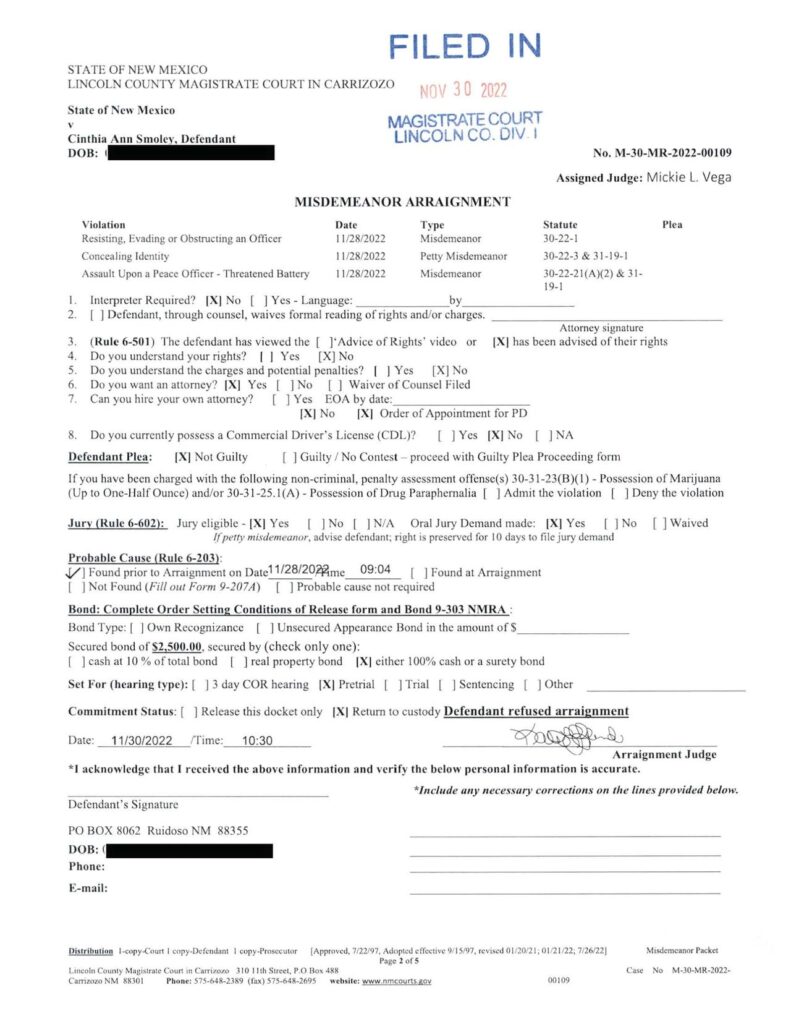
Riddle me this:
How could she have been charged with: 1. “Resisting, Evading, or Obstructing” when she was inside her home and there was no warrant and no underlying charge? 2. “Concealing identity when there was no probable cause of a “crime” (see “1.”) requiring her to disclose her identity and, 3. This is a biggie, “Assault on a peace officer” when he attacked her first, and when he was there acting as an agent for a private entity to “assist” an “eviction”, which applies to renters. Do they think a writ of assistance somehow supersedes the constitution? “The state of New Mexico is an inseparable part of the federal union, and the constitution of the United States is the supreme law of the land.” N.M. Const. Art II Sec. 1.
Incidentally…there are many other issues with this case even beyond this egregious behavior and beyond the obvious scheme/scam that is “Wall Street securitization”. We haven’t even touched on the second person in the home who was arrested and clearly is not a named defendant and is also not named on the writ. What gave them authority to forcibly remove him, even if they think they had authority to remove the named defendant? I’m pretty sure he is not “Estate of Reda Fay Smoley” and I don’t see a probate case showing that title was ever litigated against any heirs, whether or not the second arrestee was an “heir”. Either way, did they confirm his identity before arresting him on a civil “writ”?

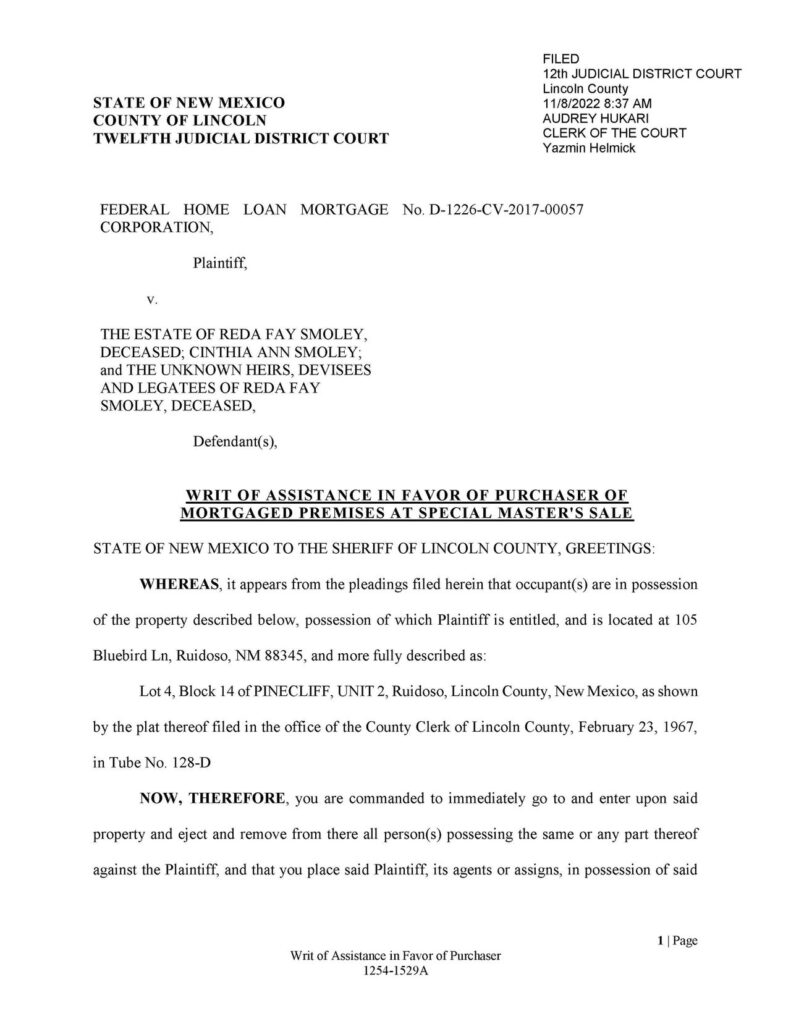
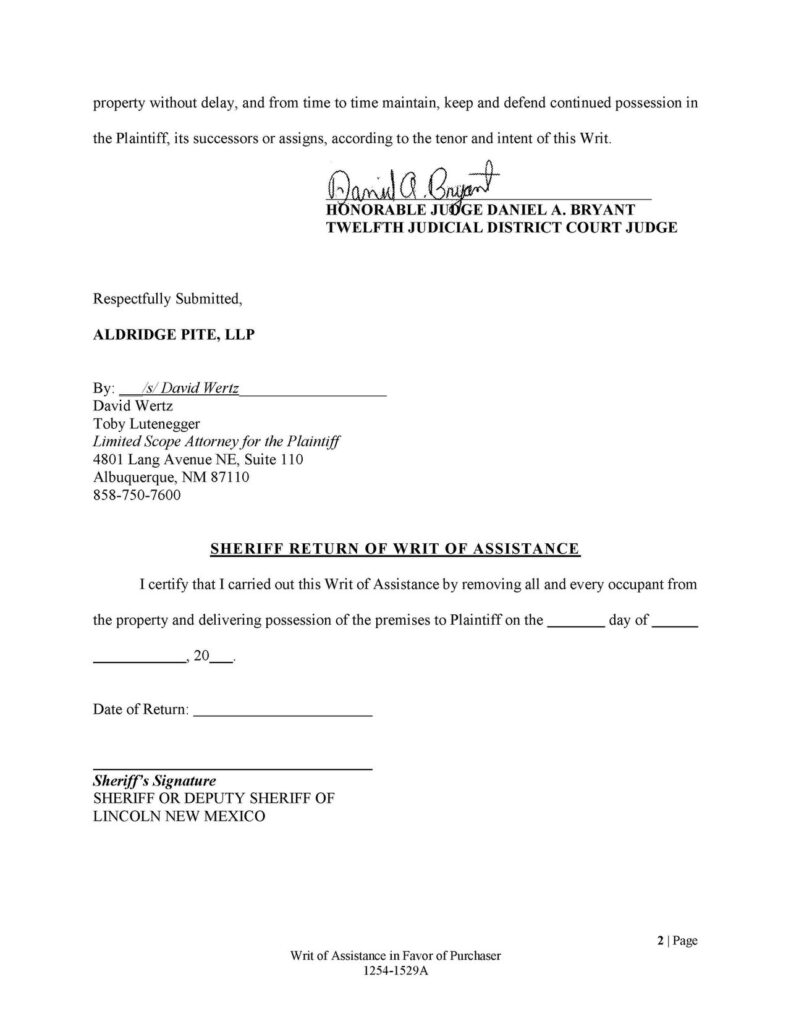
In addition to the fact that one of the defendants is “The Estate of…”, a non-existent legal entity, the judgment was issued on 11/19/2018 (Mandate on 1/6/2021); a (fraudulent) “sale” supposedly happened at some point after 1/11/2022 (see Notice of Sale on court docket) and before 2/22/2022 (see Report on court docket). This means that the “plaintiff’s” judgment was satisfied and the underlying Note was extinguished/no longer collectible. Think of an endorsed check that is ultimately cashed. You can no longer collect on that check. The plaintiff was “Bayview Loan Servicing, Inc.” and magically became Federal Home Home Loan Mortgage Corporation.
AFTER the check was cashed, e.g. the bogus “sale” satisfied the judgment, there was no longer a controversy and the case was closed. IF the process were legitimate, this is how it would go:
- A foreclosure confirms a mortgage lien, and it becomes a “judgment lien” declaring all other liens (not to be confused with title) to be inferior to the mortgage lien.
- This judgment lien can be collected on, in the same case.
- A judgment lien can be collected on through a “sale” of the lien.
- The “sale” is what converts the judgment lien into an equitable title, “special master’s deed”. At this point the judgment is satisfied and the purchaser of the lien, which now holds a “deed” must adjudicate its own rights against the property.
There is no longer a controversy with the “plaintiff”, because its judgment was satisfied and the foreclosure complaint can only allege facts related to foreclosure of the mortgage lien. The plaintiff might have had standing to foreclose on the mortgage but had no title interest in the property as of the filing of the complaint. It did not acquire a title interest until after the “deed” was executed. This means that party, whether the plaintiff was purchaser or the purchaser was some other random party, never invoked the jurisdiction of the court nor did it have standing to ask for anything because as of the filing of the complaint it was unknown whether there would be a foreclosure judgment and especially that a “purchaser” would derive some interest in the property. How could an unknown party have standing to ask the court for anything? Do you see how absurd the whole thing is? And these judges are complicit! They know better. So what is really going on?
IF the “plaintiff” was the purchaser at the “sale” (and it was all legitimate), then it becomes an equitable title-holder post-judgment and post-sale. Now it should seek to quiet its title against the title of the homeowner and, if the “purchaser” (whether it’s the plaintiff or not) could prove superior title then it would have to seek ejectment (see NMSA 1978 Sec. 42-4-1) of the person in the home, but only after title is litigated and properly adjudicated. This never happens. Instead, the “plaintiffs” and Court railroad the homeowners through smoke and mirrors, taking advantage of their ignorance of property law and land conveyance, and trick them into abandonment. Believe it or not, writs of assistance are actually rare, and only really occur when the homeowner challenges.
The writ, being assisted by the sheriff, again, is a civil process and the sheriff is not there under any “law enforcement” authority so in this way it is a “forced” abandonment of property. You know, possession is 9/10ths of the law; this has never changed.
So, it’s bad enough that these courts are plowing over the due process rights of the homeowner denying them the right to have his or her title litigated, but in this case, the Court granted a motion to substitute plaintiff and amend caption AFTER sale and AFTER a “deed” was issued! Think about that. The check had already been endorsed and cashed, and yet the court said, sure, we’ll change the name on the check, let you keep the cash, and let you steal the property without even pretending we care. The substitution of plaintiffs in foreclosure cases has become commonplace and is also not proper but at least they pretend it is by claiming that the new plaintiff took the instrument (check) via an “indorsement in blank” or whatever nonsense they use. In this case there was ZERO standing to ask the court for a writ of assistance. This will be explored further at a later date. However, recognize that because the party named on the writ did not have standing to ask for a writ, and did not ask for it under the correct statute either (e.g. no jurisdiction), the writ is void. Lincoln County Sheriff’s office is on the hook for engaging in a home invasion under the false authority of a void document, which doesn’t remotely look like a Fourth Amendment warrant.
The officers who kidnapped the homeowners at gunpoint actually admit to working with a private actor to violate their fourth amendment rights. The sworn-to statement of “probable cause” is more like probable cause to arrest him under 18 U.S.C. Sections 241 and 242.
Sergeant Jesse Finley and Deputy Kelley Gordon, are you worried yet? You should be. You acted under “color of law” to break down the door of a lawful owner and kidnapped her at gunpoint and she is now falsely imprisoned in the Lincoln County Detention Center at the request of a private party that commandeered the property and took it for itself using the Court as a shield. Can you say, “Aaargh, Pirate!”?
The party claiming a right to possession based on an inferior, equitable deed, cannot own property, nor was it a proper party in the case, nor were claims of title ever litigated, nor did they invoke the proper jurisdiction of the court… and on and on.
The fraud runs incredibly deep and because they allowed it to get to this point, those deputy sheriffs will bear the brunt and burden of the liability for Wall Street’s crimes, as will the Lincoln County Sheriff’s Office and Lincoln County residents via the County itself due to the recent change to the qualified immunity clause.
I urge you to read the criminal statutes below to understand what these sheriff deputies committed, “under color of law.”
THIS WAS A HOME INVASION!
30-14-1. Criminal trespass.A. Criminal trespass consists of knowingly entering or remaining upon posted private property without possessing written permission from the owner or person in control of the land. The provisions of this subsection do not apply if:
(1) the owner or person in control of the land has entered into an agreement with the department of game and fish granting access to the land to the general public for the purpose of taking any game animals, birds or fish by hunting or fishing; or
(2) a person is in possession of a landowner license given to him by the owner or person in control of the land that grants access to that particular private land for the purpose of taking any game animals, birds or fish by hunting or fishing.
B. Criminal trespass also consists of knowingly entering or remaining upon the unposted lands of another knowing that such consent to enter or remain is denied or withdrawn by the owner or occupant thereof. Notice of no consent to enter shall be deemed sufficient notice to the public and evidence to the courts, by the posting of the property at all vehicular access entry ways.
C. Criminal trespass also consists of knowingly entering or remaining upon lands owned, operated or controlled by the state or any of its political subdivisions knowing that consent to enter or remain is denied or withdrawn by the custodian thereof.
D. Any person who enters upon the lands of another without prior permission and injures, damages or destroys any part of the realty or its improvements, including buildings, structures, trees, shrubs or other natural features, is guilty of a misdemeanor, and he shall be liable to the owner, lessee or person in lawful possession for civil damages in an amount equal to double the value of the damage to the property injured or destroyed.
E. Whoever commits criminal trespass is guilty of a misdemeanor. Additionally, any person who violates the provisions of Subsection A, B or C of this section, when in connection with hunting, fishing or trapping activity, shall have his hunting or fishing license revoked by the state game commission for a period of not less than three years, pursuant to the provisions of Section 17-3-34 NMSA 1978.
F. Whoever knowingly removes, tampers with or destroys any “no trespass” sign is guilty of a petty misdemeanor; except when the damage to the sign amounts to more than one thousand dollars ($1,000), he or she is guilty of a misdemeanor and shall be subject to imprisonment in the county jail for a definite term less than one year or a fine not more than one thousand dollars ($1,000) or to both such imprisonment and fine in the discretion of the judge.
30-14-8. Breaking and entering.
A. Breaking and entering consists of the unauthorized entry of any vehicle, watercraft, aircraft, dwelling or other structure, movable or immovable, where entry is obtained by fraud or deception, or by the breaking or dismantling of any part of the vehicle, watercraft, aircraft, dwelling or other structure, or by the breaking or dismantling of any device used to secure the vehicle, watercraft, aircraft, dwelling or other structure.
B. Whoever commits breaking and entering is guilty of a fourth degree felony.
30-4-1. Kidnapping.
A. Kidnapping is the unlawful taking, restraining, transporting or confining of a person, by force, intimidation or deception, with intent:
(1) that the victim be held for ransom;
(2) that the victim be held as a hostage or shield and confined against his will;
(3) that the victim be held to service against the victim’s will; or
(4) to inflict death, physical injury or a sexual offense on the victim.
B. Whoever commits kidnapping is guilty of a first degree felony, except that he is guilty of a second degree felony when he voluntarily frees the victim in a safe place and does not inflict physical injury or a sexual offense upon the victim.
Note: the victim is held for ransom, as she currently has a cash or surety bond placed against her. Also, she is held to service against her will because they’re expecting her to “pay” to be released. Do you see the fine line between typical governmental action and the commission of egregious crimes?
30-4-3. False imprisonment.
False imprisonment consists of intentionally confining or restraining another person without his consent and with knowledge that he has no lawful authority to do so. Whoever commits false imprisonment is guilty of a fourth degree felony. Emphasis added. Remember the officer kept saying they weren’t under arrest? Does the “writ” give them authority to make an arrest?
30-15-1. Criminal damage to property.
Criminal damage to property consists of intentionally damaging any real or personal property of another without the consent of the owner of the property. Whoever commits criminal damage to property is guilty of a petty misdemeanor, except that when the damage to the property amounts to more than one thousand dollars ($1,000) he is guilty of a fourth degree felony.
30-16-1. Larceny.
A. Larceny consists of the stealing of anything of value that belongs to another.
B. Whoever commits larceny when the value of the property stolen is two hundred fifty dollars ($250) or less is guilty of a petty misdemeanor.
C. Whoever commits larceny when the value of the property stolen is over two hundred fifty dollars ($250) but not more than five hundred dollars ($500) is guilty of a misdemeanor.
D. Whoever commits larceny when the value of the property stolen is over five hundred dollars ($500) but not more than two thousand five hundred dollars ($2,500) is guilty of a fourth degree felony.
E. Whoever commits larceny when the value of the property stolen is over two thousand five hundred dollars ($2,500) but not more than twenty thousand dollars ($20,000) is guilty of a third degree felony.
F. Whoever commits larceny when the value of the property stolen is over twenty thousand dollars ($20,000) is guilty of a second degree felony. G. Whoever commits larceny when the property of value stolen is livestock is guilty of a third degree felony regardless of its value. H. Whoever commits larceny when the property of value stolen is a firearm is guilty of a fourth degree felony when its value is less than two thousand five hundred dollars ($2,500).
30-16-2. Robbery.
Robbery consists of the theft of anything of value from the person of another or from the immediate control of another, by use or threatened use of force or violence. Whoever commits robbery is guilty of a third degree felony. Whoever commits robbery while armed with a deadly weapon is, for the first offense, guilty of a second degree felony and, for second and subsequent offenses, is guilty of a first degree felony.
30-16-4. Aggravated burglary.
Aggravated burglary consists of the unauthorized entry of any vehicle, watercraft, aircraft, dwelling or other structure, movable or immovable, with intent to commit any felony or theft therein and the person either:
A. is armed with a deadly weapon;
B. after entering, arms himself with a deadly weapon;
C. commits a battery upon any person while in such place, or in entering or leaving such place.
Whoever commits aggravated burglary is guilty of a second degree felony.
30-16-9. Extortion.
Extortion consists of the communication or transmission of any threat to another by any means whatsoever with intent thereby to wrongfully obtain anything of value or to wrongfully compell [compel] the person threatened to do or refrain from doing any act against his will. Any of the following acts shall be sufficient to constitute a threat under this section:
A. a threat to do an unlawful injury to the person or property of the person threatened or of another; B. a threat to accuse the person threatened, or another, of any crime;
C. a threat to expose, or impute to the person threatened, or another, any deformity or disgrace;
D. a threat to expose any secret affecting the person threatened, or another; or
E. a threat to kidnap the person threatened or another. Whoever commits extortion is guilty of a third degree felony.
NOTE: This does not touch upon constitutional violations or Federal crimes.
The residents of Lincoln County should be up in arms, not just because this is how their elected officials (or employees) behave but also because of the liability foisted upon the County, which the taxpayers will ultimately be saddled with. Maybe Wall Street will pay the claims. Haha! Sure pal. They’re using you as shields. Wake UP.
DISCLAIMERS:
We are not attorneys and we do not give legal advice. This information is for educational and informational purposes only and is protected by the First Amendment to the United States Constitution.
This post contains affiliate links to information we believe you would find useful.